
Domestic households are grossly underexposed to equities.

HCL Technologies was the biggest gainer in the Sensex pack, rising 5.58 per cent, followed by Tata Consultancy Services and Infosys, State Bank of India, Tech Mahindra, Tata Steel, NTPC and Wipro. In contrast, Nestle, Bharti Airtel, Maruti and ITC were among the laggards.

Corporate India continues to be generous in rewarding its shareholders with big dividend payouts. This is especially true for shareholders of companies such as Tata Consultancy Services (TCS), Hindustan Zinc (HZL), and Coal India (CIL) which are seen as cash cows of large business groups and the government. Boosted by a big payout by these three companies, the combined equity dividend payout by listed companies was up 38 per cent year-on-year (YoY) to a record high of Rs 2.27 trillion in 2022-23 (FY23), compared with Rs 1.65 trillion in 2021-22 (FY22).

Market participants attribute the stability to the Reserve Bank of India's timely intervention in the foreign exchange market, both in terms of selling and buying dollars.

Equity benchmark Sensex ended marginally higher after a choppy session on Friday as concerns over the economic impact of the second wave of Covid-19 and pace of vaccination weighed on investor sentiment.

To minimise risk, invest in a debt fund whose duration matches your investment timeframe.

In terms of stock selection, India continues to benefit from two phenomena - the big getting bigger and availability of quality stocks in relative abundance compared with its Asian peers.

The share of foreign loans in total Adani group debt portfolio dropped to 61 per cent by September 2023 from 63 per cent as of March 2023, as the group repaid part of its foreign loans and refinanced part of older loans. The share of Indian lenders, on the other hand, rose to 39 per cent in the total debt pie in September 2023 from 37 per cent in March after a report by US-based short seller Hindenburg Research in January last year, which led to volatility in the share prices of group companies. The group's total debt remained static at Rs 2.26 trillion in the same period.

Benchmark Sensex rebounded by 167 points in a volatile trade on Friday amid buying in ICICI Bank, State Bank of India and Reliance Industries. The 30-share BSE Sensex climbed 167.06 points or 0.23 per cent to settle at 71,595.49. During the day, it hit a high of 71,676.49 and a low of 71,200.31.

The index is currently trading at 149 per cent of its historical P/B valuation, surpassing its previous peak of 125 per cent made in 2020-21.

New Delhi-based pharmaceutical major Mankind Pharma is poised to take pole position in women's health portfolio in the India Pharma Market (IPM) after completing the Rs 13,630 crore deal to acquire Bharat Serums and Vaccines (BSV), senior company officials said. The deal potentially opens doors for Mankind Pharma to the overseas markets, which currently draws 92 per cent of its revenues from India. The combined entity will draw around 13 per cent revenues from the international market, with the remaining coming from the domestic market.

In May, MFs were the net sellers in several PSUs, as they deployed Rs 47,600 crore in equities during the month.

The primary market will see a flurry of activity in March, with at least three companies including Gopal Snacks will float their initial public offerings (IPOs) in the upcoming week to raise Rs 1,325 crore collectively. The other two companies which are set to launch their maiden public issues are -- RK Swamy and JG Chemicals. Additionally, Bengaluru-based luxury furniture brand Stanley Lifestyles and Krystal Integrated Services are expected to float their initial share-sales later this month, according to merchant bankers.

The report also compares the entertainment and media market of India with China. It clearly states that the industry in India has grown because of a benign regulatory environment.

Macroeconomic data announcements, global factors and trading activity of foreign investors would be the key triggers for the domestic stock markets this week, analysts said. Last week, the benchmark indices joined the broader market's party despite a host of negative global cues. In the broader market, the BSE midcap and smallcap gauges hit their all-time highs on Friday.
Among the Sensex firms, UltraTech Cement, Reliance Industries, ICICI Bank, HDFC Bank, Bharti Airtel, IndusInd Bank, State Bank of India, Tata Consultancy Services, Larsen & Toubro, Kotak Mahindra Bank and State Bank of India were the major gainers. In contrast, Tata Motors, Maruti, Axis Bank, Mahindra & Mahindra, ITC, NTPC, Tata Steel and Bajaj Finserv were the major laggards.

Bajaj Finance was the top gainer in the Sensex pack, rising around 11 per cent, followed by Titan, Tata Steel, SBI, M&M, HDFC, IndusInd Bank and Reliance Industries. On the other hand, Sun Pharma, Nestle India and UltraTech Cement were among the laggards.

Majority of equity linked savings schemes as well as mid and small-cap funds outperformed their respective benchmark indices over a five-year period ended December 2015.

Global trends, trading activity of foreign investors, outcome of state elections and RBI's interest rate decision are the major factors that will drive the movement in the domestic equity markets this week, analysts said. "Global markets are currently in a fabulous mood. The US 10-year bond yield and the dollar index are also cooling off, which gives strength to the market. These factors will be closely monitored, as they have the potential to influence market sentiment," said Pravesh Gour, senior technical analyst, Swastika Investmart Ltd. On the political front, the results of assembly elections in five states are eagerly anticipated, Gour said.
The one-year bank deposit and the 10-year government bond finished at the bottom in terms of returns for 10-year and five-year horizons, respectively. Surprisingly, property was the worst performing asset class for the 15-year period.
The US Federal Reserve's interest rate decision, global cues, macroeconomic data announcements and the ongoing quarterly earnings are the major triggers that will dictate trends in stock markets this week, analysts said. Besides, the trading activity of foreign investors and the movement of global oil benchmark Brent crude will also be tracked. "All eyes are on the outcome of the US Federal Reserve meeting scheduled for November 1, particularly due to the multi-year high levels of the US bond yields.

From the Sensex basket, Asian Paints, Sun Pharma, HDFC Bank, Tata Consultancy Services, Axis Bank, Tata Steel, JSW Steel, Larsen & Toubro, ICICI Bank and Power Grid were the major gainers. Tata Motors dropped over 8 per cent despite reporting over three-fold jump in consolidated net profit at Rs 17,528.59 crore for the fourth quarter ended March 31, 2024. NTPC, Bharti Airtel, Titan, State Bank of India and Nestle were the other major laggards.
The market regulator's newly proposed selection criteria for the over Rs 400-trillion-a-day futures and options (F&O) market could pave the way for the entry of popular stocks such as Life Insurance Corporation (LIC) of India, Jio Financial Services, Zomato, Paytm, DMart, and Adani Energy into the derivatives segment. The Indian derivatives market, which accounts for most of the trading volumes, could see big churn with over two dozen exits from the current list of 182 stocks due to an upward revision in the eligibility thresholds.

Even as the slowdown in the information technology (IT) services sector deepens, banking, financial services and insurance (BFSI), as well as oil and gas companies, emerge as the primary drivers of corporate earnings in the country. The IT services sector's share in corporate earnings declined to a five-year low of 17.4 per cent in the second quarter (Q2) of 2023-24 (FY24), whereas banks and finance companies accounted for 46.5 per cent, and oil and gas firms contributed 16.8 per cent. At their peak, IT services firms like Tata Consultancy Services (TCS), Infosys, HCLTech, and Wipro represented just over a third of the combined net profit of all listed companies in the Business Standard sample.

Overseas investors have pulled out a net Rs 1,14,855.97 crore from the Indian markets in the current year so far, amid heightened geopolitical tensions and inflation concerns. Foreign portfolio investors have sold domestic equities worth Rs 48,261.65 crore so far this month, taking the year-to-date tally this year to a massive Rs 114,855.97 crore, according to depositories data. The exodus of foreign investors was largely owing to inflationary pressures and deepening global macroeconomic conditions following the Russia-Ukraine war, experts said.

While gold returned 12 per cent annual gain in 10 years, Nifty didn't exceed 9 per cent.

Equity markets began the new financial year with smart gains on Friday, with the Sensex rallying over 708 points to recapture the crucial 59,000-mark following gains in index majors HDFC twins and Reliance Industries, along with foreign fund inflows. On the first day of trading in the new financial year, the BSE barometer rallied 708.18 points or 1.21 per cent to settle at 59,276.69. During the day, it jumped 828.11 points or 1.41 per cent to 59,396.62. The broader NSE Nifty advanced 205.70 points or 1.18 per cent to settle at 17,670.45.

The stock of the country's largest passenger vehicle maker, Maruti Suzuki India (MSIL) was down 1.06 per cent in trade on margin pressures in Q1FY24, mixed market share outlook, and earnings impact due to the buyout of Suzuki Motor Gujarat. While MSIL has decided to terminate the contract manufacturing agreement and acquire Suzuki Motor Gujarat, the quantum of payment and mode (cash/equity swap) has not been decided. If the cash option is opted for, there would be a 3.5-4 per cent hit to MSIL's FY25 earnings per share as the deal is expected to be completed by the end of the current financial year.

PowerGrid was the top loser in the Sensex pack, shedding around 3 per cent, followed by Asian Paints, Axis Bank, Kotak Bank, Bajaj Auto, SBI and M&M.
Stock markets will focus on global trends for further direction in this holiday-shortened week as the earnings season is largely over, analysts said. Trade experts expect the key benchmark indices to move sideways as investors are trying to decode the impact of rising inflation on foreign portfolio investments. Inflation data released by the US and China last week have fanned fears of earlier than expected rate hike and boosted US bond yields.
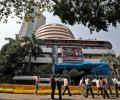
India remains one of the most over-owned market in Asia.

'API prices are dragging down margins and impacting our competitive ability.'

The recent surge in crude oil prices could shave off the gains made by India Inc in profit margins in the past few quarters. Worse, it comes at a time when consumer demand in the country is slipping and major global economies are witnessing a slowdown. A back-of-the-envelope calculation suggests that the margin expansion accounted for three-fourths of the rise in the listed firms' operating profit between the April-June quarter (Q1) of FY23 and Q1FY24, and only a quarter of profits gains came from revenue growth.

As milk prices rise, analysts have an optimistic view on dairy stocks such as Heritage Foods and Dodla Dairy, hoping the companies' margins will grow in the near to medium term. From a long-term perspective, they believe that a growing population, increasing disposable income and health consciousness will strengthen dairy consumption in India.

Most markets have seen significant erosion in investors' wealth this year

The government is expected to dole out some populist policies, especially for the rural / farm sector while presenting the interim budget, given that the country is heading towards general elections over the next few months.

Equity benchmark Sensex rallied 478 points on Monday after gains in index majors HDFC, Infosys and Kotak Bank despite a negative trend in the global markets.

Trading in the equity market this week will be highly influenced by a host of important triggers, with quarterly earnings from IT majors TCS, Wipro, and domestic inflation and IIP data taking the centre stage in dictating the movement in equities, analysts said. Besides, global factors and trading activity of foreign investors will also drive markets. "We are approaching the first quarter earnings season, with HCL Tech, TCS and Wipro set to report their earnings this week.

From the Sensex basket, Kotak Mahindra Bank, HCL Technologies, ICICI Bank, Infosys, Tata Consultancy Services, Wipro, Tech Mahindra and Larsen & Toubro were the major laggards. Mahindra & Mahindra, Nestle, Tata Motors and IndusInd Bank were among the gainers.

Stock markets will be driven by quarterly earnings by index majors, global trends and the RBI's interest rate decision this week after digesting news on budget proposals and US Federal policy outcome, say analysts. The trading activity of foreign investors and the movement of global oil benchmark Brent crude would also dictate trends in equities. "On the domestic front, the MPC (Monetary Policy Committee) meeting is scheduled from February 6-8.
